- /
How to Budget for Your First Florida Home - First-Time Buyer Tips in Bay County

 Alright, let’s talk about the part nobody really wants to talk about… the money side of buying your first home in Florida. Not the dreamy Pinterest boards. Not the “we’re getting a house!” champagne moment. The actual numbers.
Because here’s the truth. If you don’t plan for it upfront, Florida will humble you real quick.
Grab your coffee. Let’s break this down in a way that actually makes sense.
So… What Does It Really Cost to Buy a Home in Florida?
Most first-time buyers think it’s just:
- Down payment
- Monthly mortgage
I love the optimism. Truly. But we need to widen that lens just a bit.
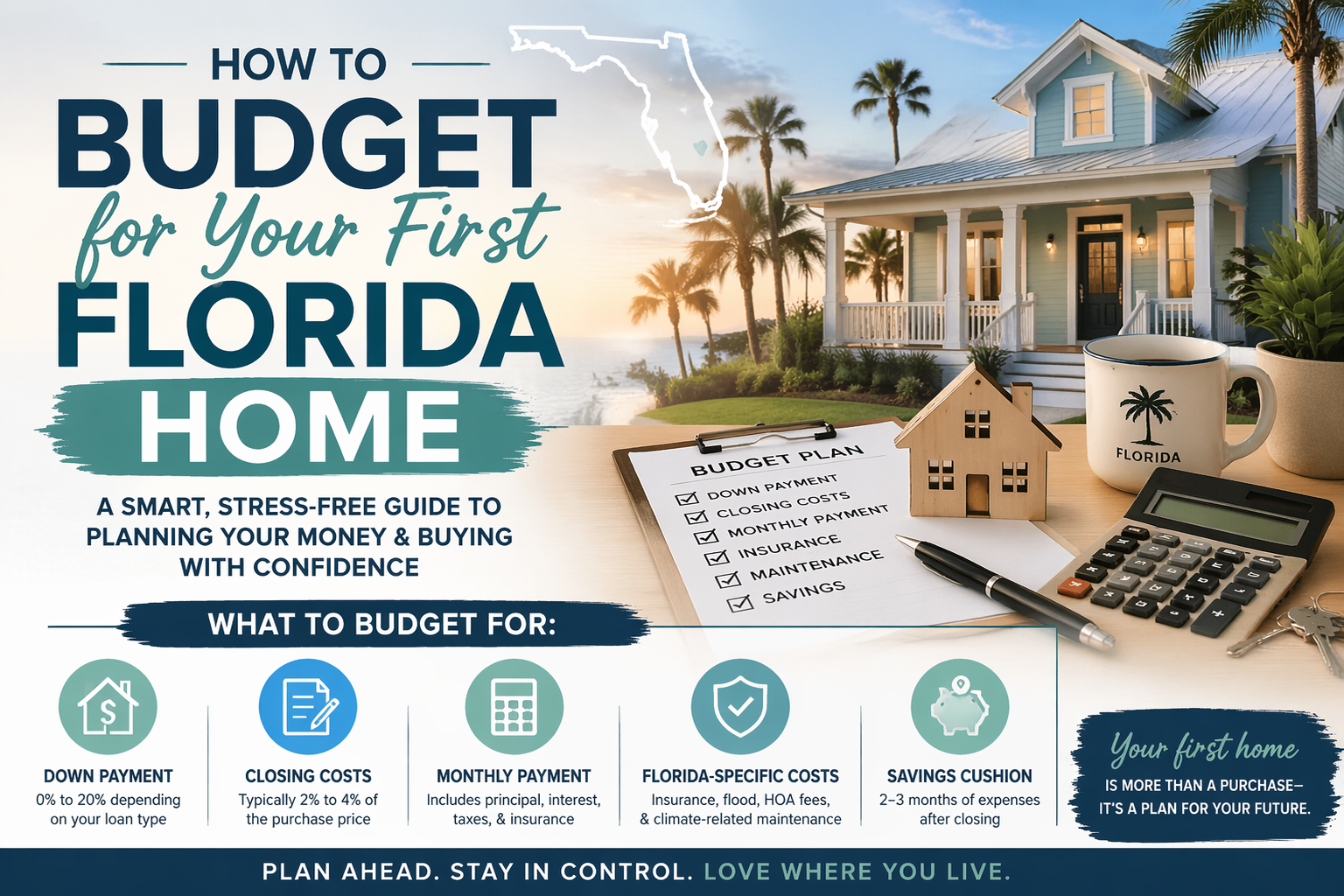
Here’s what you’re actually budgeting for:
1. Down Payment (and no, it’s not always 20%)
Depending on your loan:
- VA Loan → 0% down
- FHA → as low as 3.5%
- Conventional → typically 3% to 5% for first-time buyers
So no, you don’t need a suitcase full of cash to get started.
But just because you can go low doesn’t always mean you should. We’ll come back to that.
2. Closing Costs (the sneaky one)
This is where people get caught off guard.
In Florida, closing costs usually run about 2% to 4% of the purchase price.
That includes things like:
- Lender fees
- Title work
- Insurance setup
- Taxes and prepaid items
On a $300K house, that’s roughly $6K to $12K.
Now the good news? You can often negotiate for the seller to help cover some of this. But don’t build your entire plan around that happening.
3. Your Monthly Payment (it’s more than just the loan)
Your mortgage payment is made up of:
- Principal + Interest
- Property Taxes
- Homeowners Insurance
- Flood Insurance (if required by lender, but good to have even when it's not)
And in Florida… insurance is where things get spicy.
4. Florida-Specific Costs (this is where people get surprised)
Let’s not pretend Florida plays by the same rules as everywhere else.
Homeowners Insurance
It’s higher here. Period. Storm risk, hurricanes, all the fun stuff.
Flood Insurance
Depending on the property, this could be required… or just a really smart idea.
HOA Fees
Some neighborhoods have them, some don’t. If they do, that’s a monthly cost you need to factor in.
Maintenance in a Humid Climate
Roofs, AC units, and anything exposed to salt air don’t last forever here. Budget accordingly.
The Budgeting Mistake I See All The Time
People get approved for a number and immediately shop at the top of it.
I’m going to say this with love… don’t do that.
Your lender tells you what you can afford.
Your lifestyle tells you what you should afford.
Those are not the same thing.
You still want to:
- Travel
- Go out to dinner
- Handle unexpected expenses without panicking
House poor is not a personality trait we’re aiming for.
A Smarter Way to Set Your Budget
Instead of asking:
“What’s the max I can spend?”
Flip it to:
“What monthly payment feels comfortable without stress?”
From there, we reverse engineer:
- Purchase price
- Loan type
- Down payment strategy
That’s how you stay in control instead of feeling stretched.
Don’t Forget Your Emergency Cushion
Homeownership comes with surprises.
Not “if”… when.
Aim to have:
- 2 to 3 months of expenses saved after closing
- Extra cushion if you’re buying an older home
Because nothing kills the excitement of your first home faster than a broken AC in July with no backup plan.
Quick Reality Check Before You Start Shopping
If you can answer “yes” to these, you’re in a solid spot:
- You have money saved for upfront costs
- You understand your monthly payment range
- You’re not relying on every dollar you have to close
- You’ve planned for insurance and maintenance
If not, that’s okay. It just means we get a plan in place first.
Final Thoughts (aka your pep talk)
Buying your first home in Florida is a big deal. It’s exciting, a little nerve-wracking, and yeah… a financial commitment.
But when you walk into it with a clear plan instead of guesswork, everything feels a whole lot more manageable.
You don’t need to have it all figured out. You just need to know your numbers and make decisions that actually support your life, not stress it out.
Categories
Recent Posts